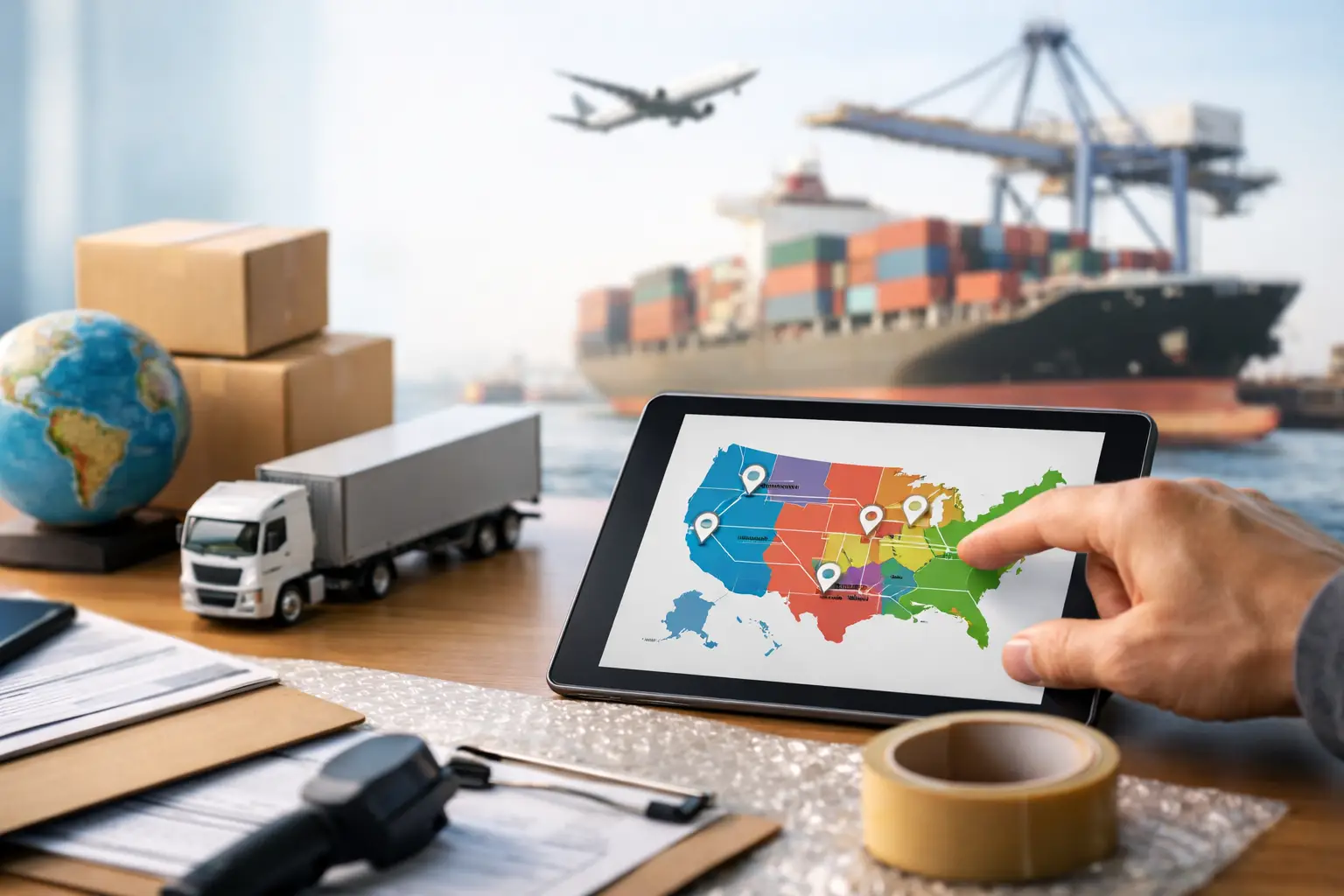

A multichannel order fulfillment service is not simply a warehouse that prints labels for Shopify, Amazon, Walmart, and eBay. For a growing seller, it is the operating layer between one inventory position and every promise made to a customer. When that layer fails, the damage shows up quickly: oversells, late shipments, canceled orders, bad reviews, marketplace performance warnings, and margin lost to expedited shipping.
The real job is to give sellers one accountable fulfillment operation while orders arrive from multiple places. That sounds straightforward until a fast-moving SKU is selling through on Amazon FBM, a TikTok campaign spikes direct-to-consumer volume, and an FBA replenishment shipment needs to leave before Amazon stock runs out. At that point, inventory control matters more than a low pick-and-pack quote.
The Core Job of a Multichannel Order Fulfillment Service
A capable multichannel provider receives inventory, stores it in an organized system, routes orders from connected sales channels, picks and packs them to channel requirements, and ships them on time. It also needs to maintain accurate inventory counts as units move through consumer orders, wholesale orders, returns, and FBA replenishment.
The distinction matters because each channel creates its own rules. Amazon FBM sellers have handling-time commitments, valid tracking requirements, cancellation-rate pressure, and delivery expectations that can affect account health. Shopify orders may require branded inserts or custom packaging. Walmart and eBay buyers expect accurate tracking and fast dispatch. Wholesale orders can require case packs, routing-guide compliance, labels, appointments, and pallet preparation.
A warehouse that only handles standard direct-to-consumer parcels may be adequate for a single-store brand. It can become a liability when the business depends on several channels with different service levels. Multichannel fulfillment is about applying the right workflow to each order without losing sight of the total inventory picture.
One Inventory Pool, Multiple Ways to Sell
The biggest operational advantage is not that orders come from different channels. It is that a seller can use the same inventory pool strategically across those channels.
Consider a brand that keeps most of its stock in a 3PL warehouse, sends smaller replenishment shipments into FBA, fulfills Amazon FBM orders directly, and ships from its own Shopify store. That structure reduces dependence on any one network. If Amazon slows receiving, limits inbound quantities, or raises storage costs, the brand still has sellable inventory positioned outside Amazon. If a product starts moving faster on the brand’s website, the seller can protect that channel instead of watching every unit disappear into FBA.
This flexibility does require discipline. A shared inventory pool only works when inventory updates are timely and allocation rules are clear. Sellers need to decide which orders receive priority when stock gets tight. For some brands, protecting Amazon Seller Fulfilled Prime or FBM performance is non-negotiable. For others, direct-to-consumer orders deserve priority because those customers generate stronger lifetime value and higher contribution margin.
There is no universal allocation rule. The right decision depends on margin, channel risk, lead times, advertising spend, and the cost of running out of stock. A fulfillment partner should help execute the rule, not make the seller discover an oversell after the fact.
Inventory accuracy is a profit issue
Inventory inaccuracies are often treated as a warehouse annoyance. They are more serious than that. A missing case of product can trigger overselling across several marketplaces. An inbound shipment received incorrectly can leave a seller believing inventory is available when it is not. A return placed back into sellable stock without proper inspection can create a new customer complaint.
Good fulfillment operations use defined receiving procedures, location control, SKU-level counting, exception handling, and regular reconciliation. Sellers should be able to understand what is on hand, what is allocated, what is in transit, what is reserved for FBA replenishment, and what is no longer sellable.
That visibility is especially valuable when a product has a long overseas lead time. If replenishment takes 60 to 90 days from purchase order to warehouse receipt, a small inventory error can become a costly stockout. The warehouse cannot eliminate supply-chain risk, but accurate information gives the seller time to react.
What Happens After an Order Drops
Order processing should feel routine to the customer, but the warehouse needs a controlled sequence behind it. The system receives the order, validates the shipping service and address data, releases it to the floor, confirms the correct SKU and quantity, applies any channel-specific packing rules, purchases the appropriate label, and pushes tracking back to the sales channel.
The details determine whether this process protects the account or creates problems. A late scan may count against an Amazon seller even when the package was packed on time. The wrong shipping method can erase profit on a low-margin order. A missed bundle component can generate a return, a negative review, and replacement shipping costs.
This is why sellers should ask more than, “Can you integrate with my storefront?” Integrations are necessary, but they are not the entire operation. Ask how exceptions are managed. What happens when an order has an invalid address, a low inventory alert, a damaged unit, a carrier delay, or a customer-requested cancellation? Who owns the decision when a marketplace order must ship that day?
A provider with experience in marketplace fulfillment understands that exceptions are where seller performance is won or lost.
FBA Replenishment Should Not Be an Afterthought
For hybrid Amazon sellers, a multichannel operation also needs to support FBA without forcing all inventory into Amazon’s network. FBA can be useful for conversion, Prime eligibility, and Amazon-managed delivery. It also comes with receiving delays, changing storage rules, inbound restrictions, aged inventory exposure, and less direct control over available stock.
Holding reserve inventory with a 3PL gives a seller options. The warehouse can prepare FBA replenishment shipments as demand requires, rather than sending oversized quantities months in advance. It can label, prep, carton, and ship inventory according to the current shipment plan. When Amazon inventory runs low, the seller has a buffer. When Amazon restricts inbound capacity, the seller still has a place to hold product without converting every decision into an emergency.
Drip-feed replenishment is particularly useful for products with reliable sales velocity but uncertain inbound timing. Smaller, more frequent shipments can help manage Amazon inventory exposure. The trade-off is that frequent replenishment requires better forecasting and closer coordination. It is not a fix for poor demand planning, but it creates more control than placing all available inventory inside FBA and hoping conditions remain stable.
The Cost Conversation Must Go Beyond Pick Fees
A low fulfillment rate can be expensive if it comes with slow receiving, poor communication, frequent errors, or weak carrier management. Sellers should evaluate total fulfillment cost, including storage, receiving, pick and pack, packaging, special projects, returns, freight, and the indirect cost of failures.
Indirect costs are often the largest. A late Amazon shipment can hurt metrics. A stockout can reduce sales momentum and ad efficiency. A mispick can create replacement costs and refund exposure. Excess inventory in the wrong place can tie up cash and generate storage fees.
That does not mean the highest-priced provider is automatically better. A simple catalog with predictable volume may benefit from a basic, cost-focused model. A brand selling bundles, fragile products, subscription boxes, Amazon FBM orders, and wholesale cartons needs more operational depth. The service level should match the complexity and risk of the business.
Questions That Reveal Whether a 3PL Can Handle Growth
Before moving inventory, sellers should get specific about the operation. Ask how long receiving takes after a container, pallet, or parcel delivery arrives. Ask whether the warehouse can separate sellable, damaged, returned, and FBA-designated inventory. Ask how inventory counts are corrected and how quickly issues are communicated.
It is also worth asking who monitors marketplace shipping deadlines, how tracking is uploaded, and what support looks like during peak volume. A fulfillment partner should have a clear answer for a sudden order spike, not a vague assurance that capacity will be available.
For multichannel brands, the best question is often this: can the provider help us make better inventory decisions, or does it only move boxes after we make them? The first model gives sellers control. The second can work, but it leaves the brand carrying more operational burden internally.
FBMFulfillment approaches this work from the seller’s side of the operation, where FBA constraints, FBM metrics, and stockout risk are daily realities rather than abstract service categories.
Build for the Channel You Need Next
The right fulfillment setup should support the sales channels that matter now while leaving room for the next one. That may mean holding reserve stock outside Amazon, protecting direct-to-consumer inventory during promotions, or adding wholesale fulfillment without disrupting consumer orders.
Growth is rarely a straight line. A dependable multichannel operation gives sellers room to respond when demand shifts, policies change, or one channel becomes less favorable. The practical goal is simple: keep inventory visible, keep orders moving, and keep more of the decisions inside your business rather than inside someone else’s warehouse process.