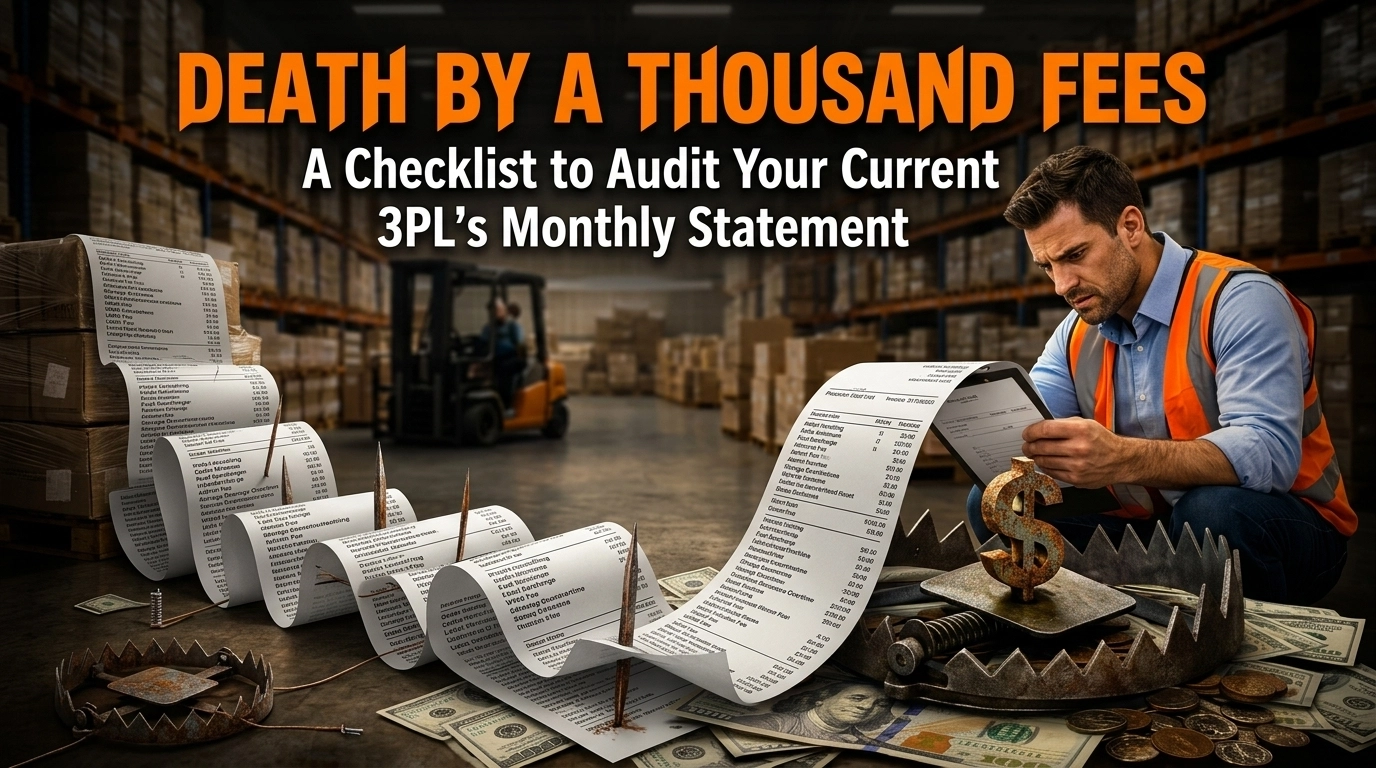
You just opened your monthly fulfillment invoice, and your stomach dropped. You sold more than ever last month, so why is your profit margin thinner than a shipping label? It isn’t the shipping rates. It isn’t the returns. It’s the “paper cuts.” Most ecommerce sellers are victims of a 3PL monthly statement audit gone wrong: or rather, one that never happened. Your 3PL isn’t just a service provider; in many cases, they are a silent partner taking a massive, unearned cut of your hard-earned revenue through “hidden” fee structures that feel more like a heist than a business agreement.
The ecommerce boom has fueled a surge of warehouse providers who prioritize their own bottom line over your scalability. These startups and legacy 3PLs alike often present a “clean” rate card only to bury you in a mountain of line items that were never discussed. Given the significant risks to your cash flow, you cannot afford to ignore the fine print any longer. It is time to pull back the curtain on the industry’s most precarious billing practices.
The “Big Three” 3PL Storage Scams
Before we dive into the checklist, you need to understand the “Big Three.” These aren’t just mistakes; they are intentional pricing models designed to extract maximum cash from your inventory while providing minimum value. If you see these terms in your contract, you are in a precarious position.
1. The Monthly Snapshot
Perhaps the most devastating of all storage tricks is the 3PL monthly snapshot. Here is how it works: the warehouse takes a “picture” of your inventory levels on the first day of the month. They then bill you for that entire volume for the next 30 days.

Imagine you have 1,000 units on the 1st, but you run a massive sale and sell 900 of them by the 5th. In a fair world, you’d only pay for those 100 remaining units for the rest of the month. In the snapshot world? You pay for 1,000 units all month long. You are paying for “ghost inventory” that isn’t even in the building. Voilà you are covered AUTOMATICALLY in their pocket, not yours.
2. The Logical Pallet Trap
One of the biggest red flags in ecommerce fulfillment costs is the “pallet rate” that isn’t actually a pallet rate. We call this the logical pallet trap.

A 3PL might offer you a “low” rate of $15 per pallet. Sounds great, right? But their WMS (Warehouse Management System) is set up to bill you for a full pallet the moment a single SKU touches it. If you have 50 different SKUs, and each has only 5 boxes left, you aren’t paying for the physical space of 2 pallets. You are paying for 50 “logical” pallets. You are paying for air. This is how a “cheap” storage rate turns into a catastrophic risk for your margins.
3. The Ghost Space Trick
Many 3PLs charge for “allocated” or “reserved” space. This is ghost space. They claim they are holding a specific zone for your brand, so you must pay for it whether it’s full or empty. This prevents you from being agile. When your inventory dips, your costs should dip too. If they don’t, you are essentially paying your 3PL’s rent while they use the “empty” space to store someone else’s product.

The Ultimate 3PL Monthly Statement Audit Checklist
It is time to get aggressive. Pull up your last three months of invoices and run them through this checklist. If you find more than two “Yes” answers, you are being overcharged.
1. Identify the “Unaccounted” Line Items
Does your invoice contain fees that aren’t on your original signed rate card?
- Technology Fees: Are you paying $500/month just for the privilege of using their software?
- Account Management Fees: Are you being billed for “support” that only consists of them answering your angry emails about shipping delays?
- Inbound Receiving Surprises: Are there “sorting” or “unloading” fees that weren’t disclosed?
2. Verify the Storage Calculation
This is where most of the “bleeding” happens. A proper fulfillment invoice audit requires looking at the “Storage” section with a magnifying glass.
- Daily vs. Monthly: Is the storage billed daily (prorated) or as a monthly snapshot? (Hint: If it’s a snapshot, you’re losing).
- Cubic Feet vs. Pallet: Are they billing by actual cubic feet used or by “logical” pallets?
- Minimums: Is there a “monthly storage minimum”? These are often set at levels that punish growing sellers during their lean months.
3. Audit the Shipping Markups
Check your shipping costs against carrier list rates.
- Fuel Surcharges: Many 3PLs add an additional fuel surcharge on top of the carrier’s already inflated surcharge.
- Residential Surcharges: Are they double-dipping?
- Dimensional Weight (DIM): Is your 3PL recalculating postage based on dimensions and keeping the difference without telling you?
4. Look for “Labor” Padding
- Dunnage Fees: Are they charging you per air pillow or per inch of tape?
- Pick-and-Pack Minimums: Are you charged a minimum “order fee” even if the order only takes 10 seconds to pack?
- Return Processing: Are you paying for a “return fee” plus a “restocking fee” plus a “disposal fee” for the same item?
Why FBMFulfillment Is the Honest Alternative
At FBMFulfillment.com, we were built from an experienced seller’s perspective. We’ve felt the pain of opening an invoice and feeling like we just got mugged. That’s why we’ve built our model to be the total opposite of the “legacy” 3PL trap.
We don’t believe in hidden 3PL fees. We believe in Operational Excellence.
- Daily Prorated Cubic Feet: We only charge you for the space you actually use, calculated daily. If you sell out on the 10th, you stop paying for that space on the 10th. Period.
- No Long-Term Contracts: We earn your business every single month. If we don’t perform, you should be free to leave. We don’t hold your inventory hostage.
- No Onboarding Fees: Why should you pay us to become our customer? We want you to succeed from Day 1.
- Inventory Possession Control: Your stock is never “stuck” in a complex system. You have total control over your multichannel fulfillment inventory pool.
- Actual 2-Day Delivery: We don’t play games with “Prime” labels that take 5 days to arrive. We use FedEx 2Day to ensure your customers actually get what they paid for.
Final Steps: Don’t Let the Bleeding Continue
Unfortunately, many sellers realize they are being overcharged only when it’s too late and their cash flow has dried up. Be cautious of “too good to be true” pallet rates that hide the logical pallet trap. Exercise extreme caution when signing contracts that include “monthly snapshots.”
Best Solution: If your current 3PL fails this 3PL monthly statement audit, it is time to move. Transitioning might seem daunting, but the long-term cost of staying with a predatory provider is devastating.
Contact us at FBMFulfillment.com and we will be glad to help you perform a free audit of your current invoice. We’ll show you exactly where the “hidden” fees are and how our transparent, seller-first model can put that money back into your pocket.