You just received your monthly storage bill, and your jaw is on the floor. You know exactly how much inventory you sent to the warehouse. You counted the pallets yourself. So why is your 3PL charging you for 40 pallet positions when you only have 4 physical pallets sitting on their floor? Welcome to the “Logical Pallet Trap.” If you’re trying to scale your brand while using b2b order fulfillment services, this hidden billing tactic is likely the single biggest leak in your profit margins.
At FBMFulfillment.com, we see this constantly. Founders come to us frustrated, feeling like they’re being “nickeled and dimed” to death. The reality is actually worse: you aren’t just being charged small fees; you’re being charged for “Ghost Space”, air that doesn’t exist, created by a software setting in a Warehouse Management System (WMS). This is a common pitfall in 3pl fulfillment prep that most sellers don’t realize until they’ve already signed a long-term contract.
WHAT IS THE LOGICAL PALLET TRAP?
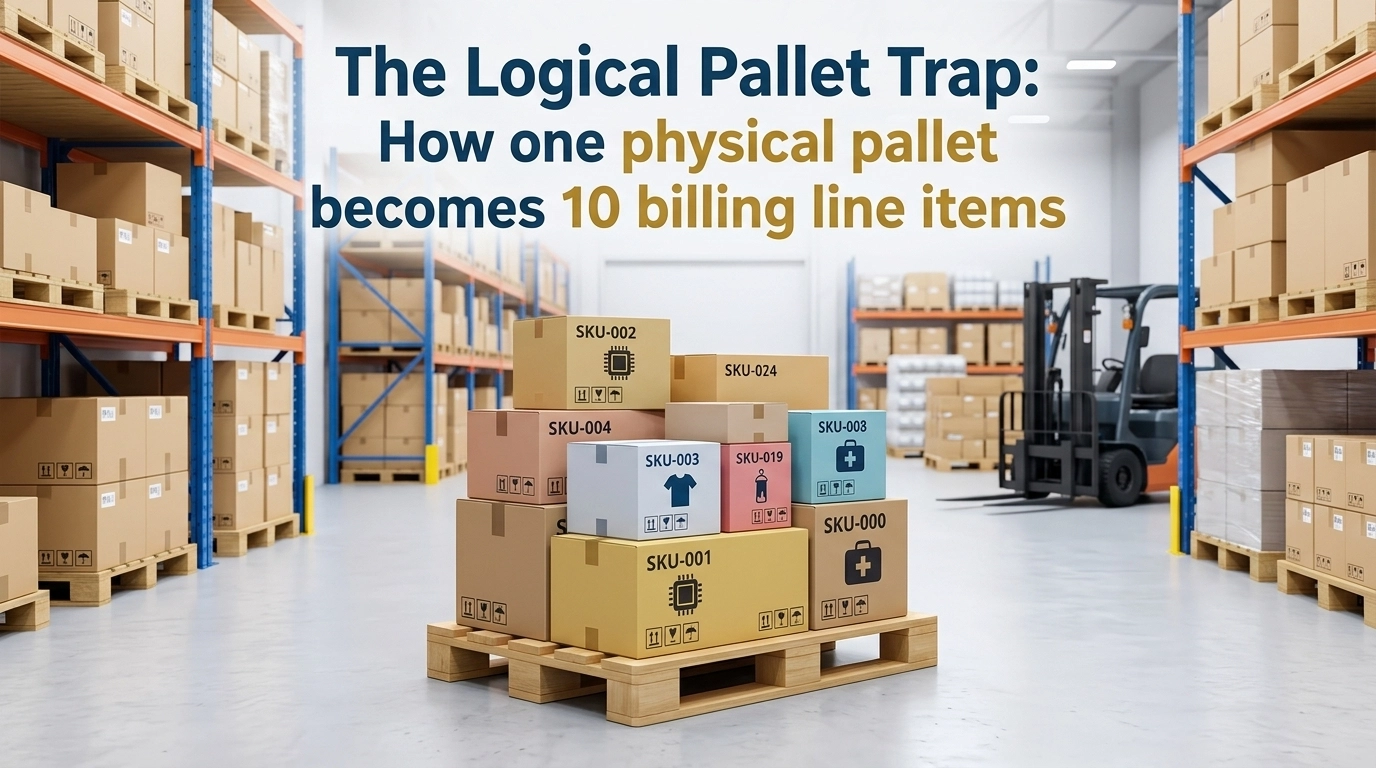
Most traditional 3PLs use software that simplifies their billing but complicates your life. In their system, a “pallet” isn’t a physical object made of wood; it’s a “logical” position. If their software is configured to associate one SKU per pallet position, the moment you put two different SKUs on a single physical pallet, the system sees two pallets.
Imagine you have 10 different SKUs. Each SKU has only 5 units left. In a rational world, those 50 total units would sit on one physical pallet. But in the “Logical Pallet” world, you are billed for 10 pallets. You are paying for 9 empty pallet spaces that the 3PL is likely using to store someone else’s inventory. You are essentially subsidizing their warehouse rent while your margins bleed out. This is why choosing the right b2b order fulfillment services is about more than just the “per-pick” cost; it’s about how they calculate the space you actually occupy.
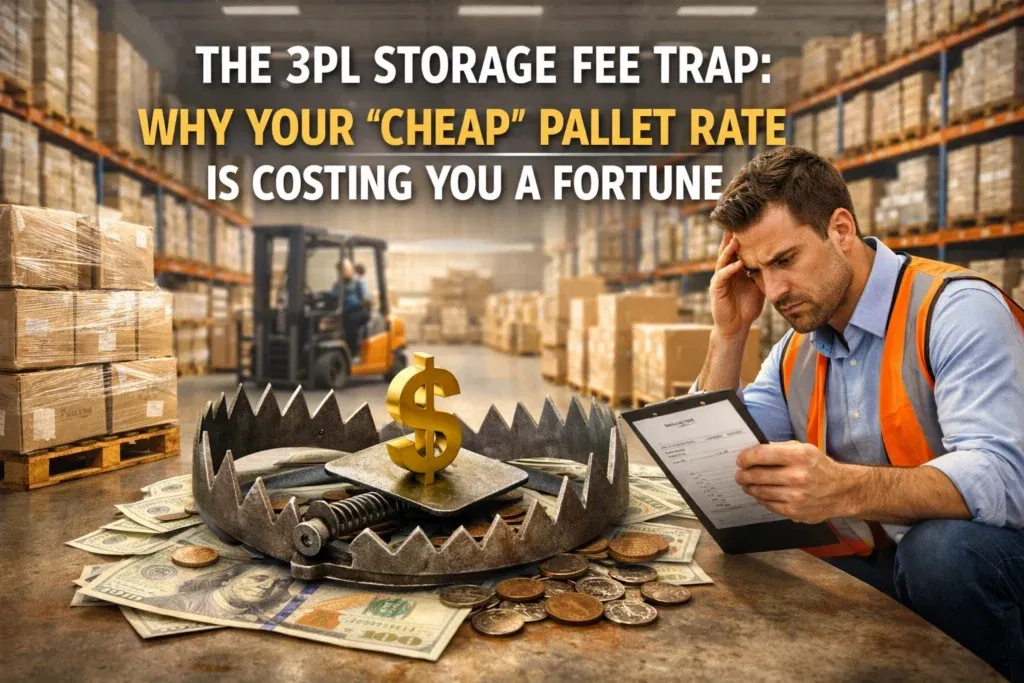
THE MATH OF MARGIN BLEED
Let’s look at the numbers because they are devastating. If a physical pallet costs $25/month to store, and you have 10 SKUs spread across that one pallet, a “Logical Pallet” 3PL is charging you $250/month for that same space.
Over a year, that’s $3,000 for a single pallet position.
If you have 100 SKUs (which is common for apparel or electronics brands), the “Logical Pallet” math becomes catastrophic. You might have the physical volume of 10 pallets, but you’re being billed for 100. That’s an extra $2,250 per month in pure “Ghost Space” fees. For a growing brand, that’s the difference between being profitable and going out of business. This is why 3pl fulfillment prep must include a deep dive into the storage billing logic before you ship a single box.
WHY TRADITIONAL 3PLS LOVE “GHOST SPACE”
Why do they do it? Because it’s easy money. Managing “mixed SKUs” on a single pallet requires more labor and better organization. It requires a warehouse team that actually cares about density and consolidation.
Most big-box 3PLs would rather just let the software run on autopilot. If their system says you have 50 “logical” pallets, they bill you for 50. It doesn’t matter if their warehouse floor is half-empty; their “billing floor” is at maximum capacity. When looking for b2b order fulfillment services, you need to ask a specific question: “Do you bill by physical pallet footprint or by SKU-based logical positions?” If they hesitate, you have your answer.
B2B ORDER FULFILLMENT SERVICES: THE SCALE PROBLEM
The problem gets even stickier when you move into wholesale. B2B order fulfillment services often involve larger quantities, but also more SKU complexity. If you are prepping a wholesale order for a retailer like Walmart or Target, you might have multiple SKUs destined for the same location.
If your 3PL is trapping you with logical pallet billing during the 3pl fulfillment prep stage, your cost to fulfill that wholesale order skyrockets. You aren’t just paying for the labor to pick and pack; you’re paying for the “privilege” of having your inventory sit in their system as separate entities.
At FBMFulfillment, we built our system from a seller’s perspective. We know that every dollar spent on “Ghost Space” is a dollar taken away from your ad spend or product development. We aggregate volume across SKUs and locations to ensure you pay for what you use, not what a computer script says you use.
3PL FULFILLMENT PREP: HOW TO PROTECT YOURSELF
Before you commit to a new partner, you need to conduct your own “stress test” of their billing model. Here are key steps to avoid the Logical Pallet Trap:
- Demand a “Mixed SKU” Policy: Ask in writing how they bill for pallets that contain multiple SKUs.
- Audit the WMS: Ask for a screenshot of how a pallet with 5 SKUs appears in their billing dashboard.
- Check for Consolidation Fees: Some 3PLs will say they don’t use logical billing, but then they charge a “consolidation fee” every time they move your items to save space.
- Verify B2B Order Fulfillment Services Logic: Wholesale orders shouldn’t be penalized for SKU diversity. Ensure your b2b order fulfillment services provider treats a pallet as a pallet, regardless of what’s on it.
- Look for Actual 2-Day Delivery: Don’t let them hide storage fees behind “cheap” shipping. Often, the 3PLs with the most aggressive “logical” billing are the same ones using inconsistent shipping methods. At FBMFulfillment, we use FedEx 2Day service to ensure your customers get their orders on time, every time, without the storage games.
THE FBMFULFILLMENT DIFFERENCE: NO GAMES, JUST GROWTH
We didn’t start FBMFulfillment because we wanted to be landlords; we started it because we were e-commerce sellers who were tired of being lied to. We’ve experienced the pain of the “Logical Pallet” first-hand. That’s why our 3pl fulfillment prep process is designed to maximize your density.
If we can fit your 10 SKUs on one physical pallet, we will. And we will bill you for one pallet. Voilà: you are covered AUTOMATICALLY. Our goal is to keep your inventory moving, not to let it sit and collect “Ghost Space” rent. Whether you are running a TikTok Shop or managing a massive Shopify multi-channel pivot, your fulfillment partner should be an accelerator, not a anchor.
Don’t let your margins bleed out into the pockets of a warehouse landlord. Demand transparency. Demand physical billing. And if your current provider won’t give it to you, it’s time to move your inventory to a partner that understands the seller’s reality.
Contact us at FBMFulfillment.com and we will be glad to help you audit your current storage costs and show you the path to true profitability.
https://fbmfulfillment.com/fbmfulfillments-technology-edge-master-the-pallet-to-each-inventory-chain/
Key Takeaways
- The Logical Pallet Trap results in inflated 3PL storage fees due to billing systems that charge for ‘ghost space’ rather than actual inventory.
- B2B order fulfillment services should consider how space is calculated; logical pallet billing can drastically increase costs without physical justification.
- Founders must audit potential 3PL partners to ensure they bill based on physical pallets, not SKU-based logical positions.
- At FBMFulfillment, the focus is on maximizing density and transparency, seeking to minimize unnecessary costs associated with ‘ghost space’.
- Take steps to protect your business by demanding clear policies on mixed SKUs and verifying billing practices before signing contracts.