
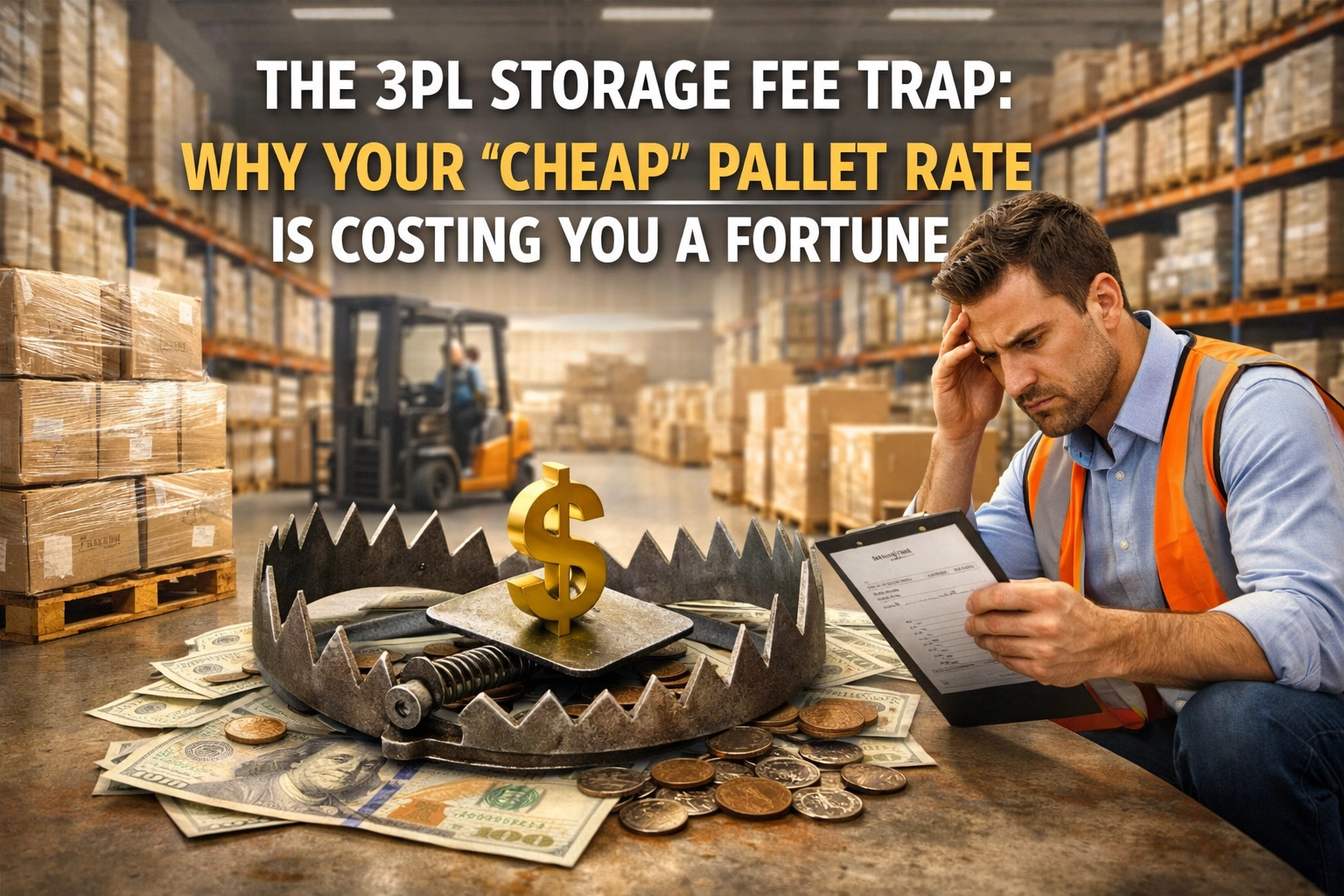
You’ve seen the ads. “$15 per pallet storage!” or “Lowest storage rates in the industry!”
It sounds like a dream for your margins. You do the math, sign the contract, pay the $2,000 “onboarding fee,” and spend three weeks integrating your Shopify store with their clunky WMS. Your inventory arrives, the first month passes, and then: BAM.
The invoice hits.
It’s double what you calculated. Triple, maybe. You look at the line items and realize you’ve been played. But now your stock is already in their 3pl warehouse, your systems are linked, and the thought of moving everything again makes you want to quit the business entirely.
This isn’t an accident. It’s a strategy.
At FBMFulfillment.com, we see this every single day. Sellers come to us after being burned by the “Cheap Pallet” trap. Today, I’m going to pull back the curtain on how many 3rd party logistics companies actually calculate storage and why that “cheap” rate is the most expensive mistake you’ll ever make.
1. The Pallet Position Illusion (The “Ghost Space” Problem)
Most ecommerce fulfillment center providers charge by the “pallet position.” On the surface, it makes sense. You have a pallet; it takes up a spot; you pay for the spot.
But here is the catch: Pallets aren’t static nor are they always a single sku.
Imagine you send in 10 full pallets of product. Over the next two weeks, you sell 60% of that stock. In a perfect world, you’d only pay for the space those remaining items occupy. But in the “Pallet Position” world, those 10 pallets are now 10 half-empty pallets.
The 3pl warehouse isn’t going to consolidate them for you for free. They’ll keep those 10 pallets sitting in 10 different slots, and guess what? You are paying for 10 full slots. You are literally paying for “Ghost Space”: the air where your sold products used to be.
2. The Monthly Snapshot Scam
This is the most “predatory” tactic in the industry. Many 3pl services take a “snapshot” of your inventory on the 1st of the month.
- This does not mean that inventory received during the month is not counted. It is nomally charged for the whole month even though it has only been in stock a single day.
- Inventory moves may also inflate storage fees in many WMS systems. Example, if you have Pallet A in location 111 and do any stock reorganization during the month moving it to location 222, they will charge you for a month’s storage in location 111 and 222 for the same inventory. That’s right you just got double billed!
- If you have 100 pallets in the warehouse on the 1st, they bill you for 100 pallets for the entire month. Even if you run a massive promotion and sell 90 of those pallets by the 5th, you are still paying for 100 pallets for the next 25 days.
It’s a guaranteed win for the 3PL and a catastrophic loss for your cash flow. They are charging you for space they are already using to store someone else’s inventory.

3. The “Lock-In” Strategy: Why They Want You Stuck
You might wonder: “John, if their fees are so deceptive, why don’t people just leave?”
Because they make it painful. Intentionally.
The 3rd party logistics companies that use these complex billing models almost always require:
- Hefty Onboarding Fees: They’ll charge you $1,000 to $5,000 just to “set up” your account.
- Long-Term Contracts: You’re locked in for 12 months or more.
- Integration Debt: They make the setup so complicated that the “switching cost” of moving to a new provider feels impossible.
They know that once your stock is in their racks, you are a hostage. They know the dissatisfaction of paying for “Ghost Space” is slightly less painful than the cost and resource investment of shipping 50 pallets to a new warehouse and paying another onboarding fee.
4. FIRST INVOICE SHOCK?
This is the moment it clicks. And it’s brutal.
By the time that first real bill arrives, you finally see the overcharge for what it is: you’re paying for ghost space you already sold through. Empty air. Half pallets billed as full pallet positions. Snapshot months billed like you never ran a promo. Sometimes it is not obvious until the second or third invoice.
Unfortunately, this is also the moment you realize you’re trapped.
Because you didn’t just “choose a warehouse.” You already:
- Paid thousands in onboarding fees
- Burned weeks of technical setup (Shopify/WMS mapping, shipping rules, carrier accounts, user permissions, API connections)
- Survived the massive logistical headache of inbounding inventory (pallet builds, labels, appointments, freight claims, ASN drama, receiving delays)
So you enter the phase I hear sellers describe the same way every time:
The “Suck it up” phase.
You don’t like the invoice. You know you’re being billed wrong. But switching feels worse. The switching cost is the weapon. They’re betting you’ll stay because leaving is too expensive, too slow, and too disruptive.
That’s the point. Buyer’s remorse… with a contract attached.
Here’s the difference at FBMFulfillment.com
We don’t run a high-barrier entry model. No onboarding fees at all. No long-term contracts. No “you’re stuck now” energy. Yes onboarding costs us money, but this is money that we are willing to invest for the long term relationship with your company.
We earn your business every month.
That changes everything:
- We bill in a way that doesn’t create ghost space in the first place (daily prorated aggregated volumetric cubic feet)
- We can’t hide behind a contract if you’re unhappy
- You don’t get that “how did I end up here?” feeling after invoice #1 or invoice #12
FBM clients don’t experience this buyer’s remorse. They see the math immediately. And they keep control.
5. The FBMFulfillment Difference: Simple and Honest Daily Proration (and Aggregated Volume)
When we started FBMFulfillment.com, I decided we were going to do the exact opposite. We don’t want hostages; we want partners. If we aren’t providing value, you should be able to leave. Period.
That’s why we use a Daily Prorated Cubic Foot model built around Aggregated Volume.
How it works:
We don’t care about “pallet positions” or “snapshots.” We calculate the exact cubic volume of your inventory daily, so your fees naturally drop as you sell through your inventory.
- The Model: Daily actual prorated cubic feet (not monthly pallet position math).
- The Aggregation: Volume is aggregated across SKUs, Units of Measure (pallets, master cartons, and eaches) and locations.
- The Benefit: You pay for the physical space used, not the billing category your inventory happens to be sitting in this week.
The “Logical Pallet Trap”?
Here’s one of the sneakiest storage games in the industry.
Many 3PLs bill “per pallet position” in a logical way, not a physical way:
- You can have 10 SKUs on one physical pallet
- But their system counts each SKU as its own pallet position in their system. In other words, they do not allow more than one sku in a pallet position.
- So you get billed like you have 10 pallets when you really have 1
Oh but it gets worse, Most
Catastrophic for high-SKU brands. Instant margin leak. And the worst part? You usually don’t see it until the invoice is already baked.
What we do instead at FBMFulfillment.com
We aggregate your storage by actual volume across whatever mix your business needs:
- Multiple SKUs sharing the same pallet? Fine.
- Some inventory in pallets, master cartons, some in eaches? Fine.
- Your business model requires several variants (SKUs)? Normal Our owner’s brand UFM Underwear has more than 700 skus.
You only pay for the real space your inventory occupies in our 3pl warehouse. Not “10 pallets” because your WMS calls it 10.

There is no “Ghost Space.” You only pay for what is physically sitting in our 3pl warehouse at that exact moment. It is the most honest way to bill, and it’s the only way that keeps our interests aligned with yours. When you sell more, your storage fees go down automatically.
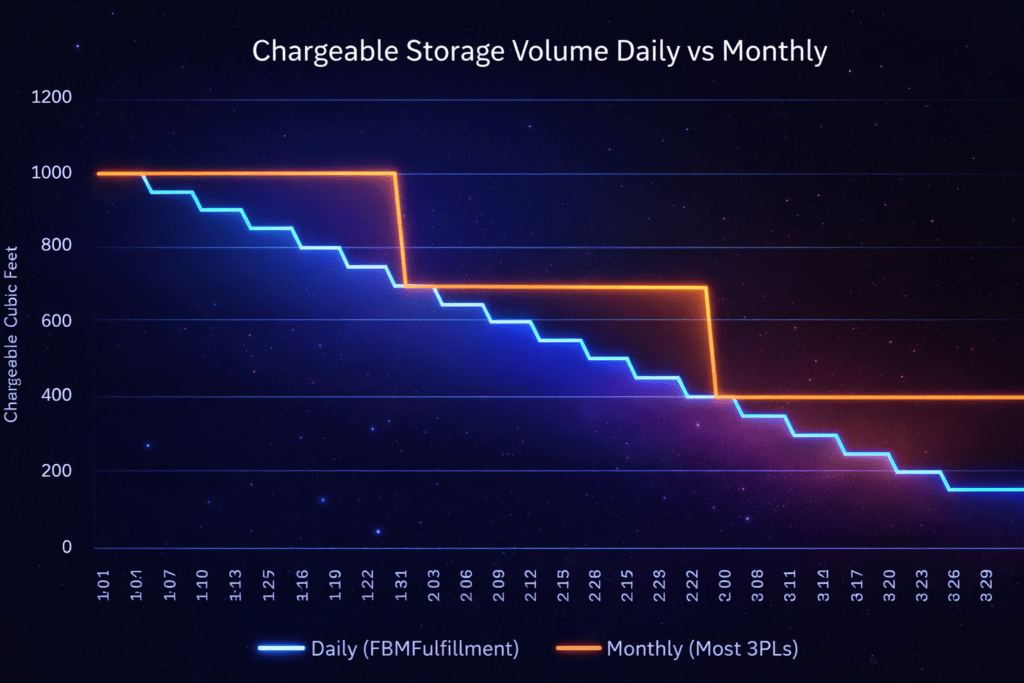
Infographic comparing “Monthly Snapshot Billing” showing a flat high bar vs “FBM Daily Proration” showing a declining line as stock sells
Why don’t all 3Pls calculate storage fees this way? 2 Reasons
- To inflate their margins and allow them to deceptively advertise lower storage fees,
- Their old technology does not support tracking inventory at such a sophisticated level.
Why Amazon AWD is not the answer either.
We take a deep dive into AWD fee calculations in the article: Amazon AWD Vs. FBMFulfillment: Which Is Better for Your Multi-Channel Margins?
5. Why We Have No Contracts and No Onboarding Fees
Most 3PLs think I’m crazy for this. “John, how do you protect your downside?”
The answer is simple: Service quality is the only contract we need.
If we do a great job: if we ship your orders same-day, maintain 99.9% accuracy, and charge you fairly: why would you leave?
By removing onboarding fees and contracts, we put the pressure on ourselves to perform. We don’t want you to stay because it’s too expensive to leave. We want you to stay because you can’t imagine a better partner for your ecommerce fulfillment center needs.
6. Understanding “3PL Meaning” in 2026
The 3pl meaning has shifted over the last few years. It used to just mean “a place to put my stuff.” Now, a 3PL is a data partner, a shipping strategist, and a protector of your bottom line.
If your current provider is hiding behind “Pallet Rates” and “Account Management Fees,” they aren’t a partner. They are a landlord. And a bad one at that.
When you look at 3pl services, you have to look past the base rate. You have to ask:
- “How do you handle partially empty pallets?”
- “Do you bill based on a monthly snapshot or daily averages?”
- “What are my exit fees?”
If the answers are vague, run.

The “Buyer’s Remorse” Test
Ask any seller who has switched 3PLs three times in two years about “Buyer’s Remorse.” It usually sets in around month three, when the “introductory pricing” expires and the hidden fees start creeping in.
Our clients don’t experience that. Why? Because there’s nothing to hide.
- No $2,000 “Implementation Fee.”
- No $500 “Monthly Account Maintenance Fee.”
- No charging you for empty air in a rack.
Whether you are scaling on TikTok Shop or managing a complex FBA drip-feed strategy, your storage should be a variable cost that reflects your actual inventory levels: not a fixed penalty for having a successful sales day.
Final Word: Do the Math
If you are currently paying $15/pallet, but those pallets are only 50% full on average, you aren’t paying $15. You are paying $30.
If you are paying for a “Monthly Snapshot” on the 1st, but your inventory turns over every 15 days, you are paying double for space you aren’t using.
Stop falling for the trap. Look for transparency. Look for daily proration. And most importantly, look for a partner who doesn’t need a 12-month contract to keep your business.
If you’re tired of the “Ghost Space” invoices and want a simple, honest breakdown of what your fulfillment should actually cost, reach out to us at FBMFulfillment.com. We’ll give you a straight answer, no strings attached.

Key Takeaways for your 3PL search:
- Daily Proration > Monthly Snapshots: Always.
- Cubic Volume > Pallet Positions: It eliminates the “Ghost Space” tax.
- No Contract = Confidence: If they need a contract to keep you, their service probably won’t.
- Onboarding Fees are Red Flags: It’s just a way to increase your switching costs so you can’t leave when you realize the billing is deceptive.
Stay sharp, keep your margins protected, and don’t let a “cheap” rate ruin your brand’s growth.
Amazon AWD Vs. FBMFulfillment: Which Is Better for Your Multi-Channel Margins?
Best 3PL Fulfillment Companies for Small Businesses in the US
Stop Paying for Air: The Daily Proration vs. Monthly Snapshot Scam