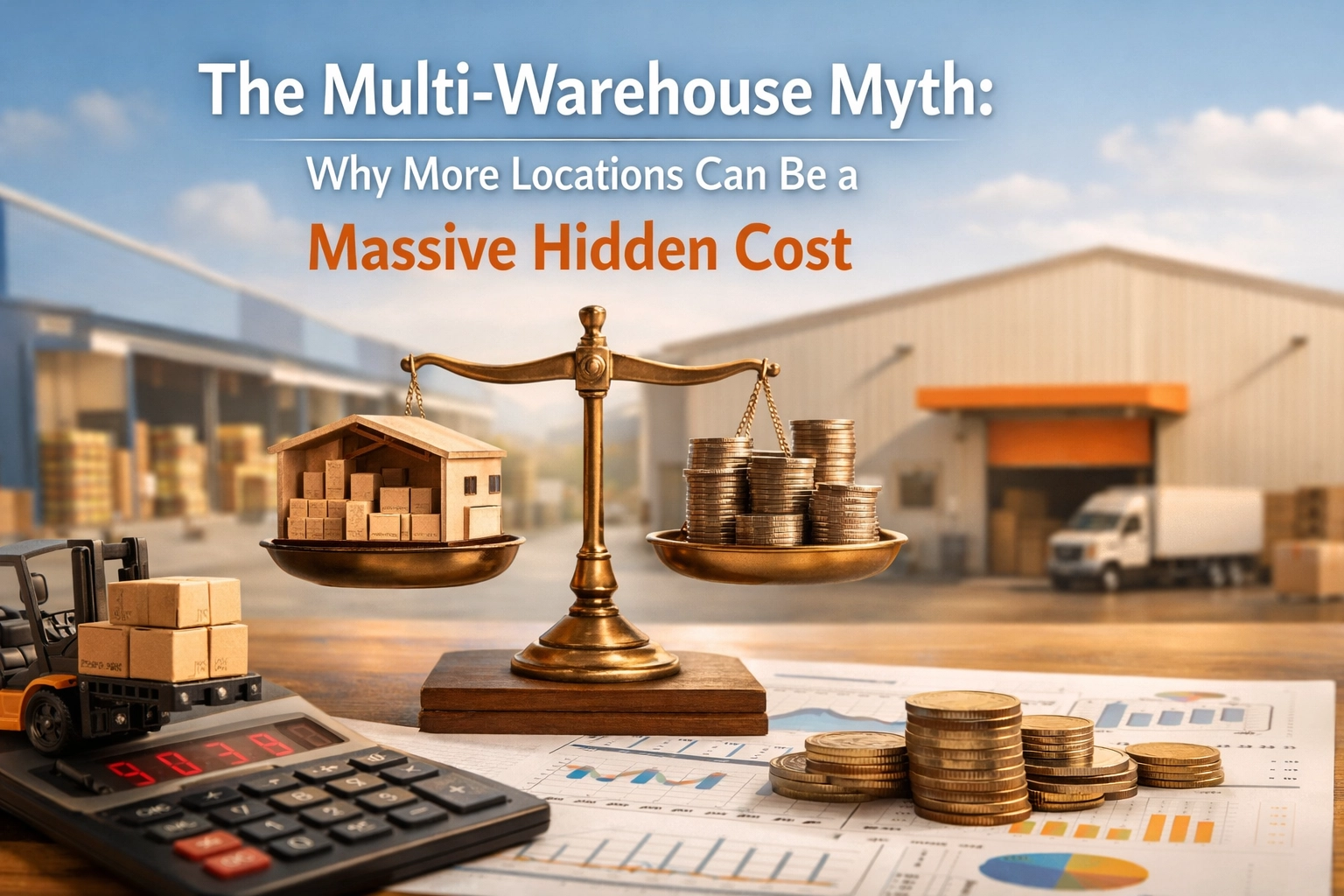
It’s the dream every growing e-commerce brand is sold: “Move your inventory closer to your customers! Lower your shipping zones! Save a fortune on postage!”
On paper, the multi-warehouse strategy looks like a masterstroke of logistics genius. You see the maps with five or six dots scattered across the country, and you imagine your packages flying to customers in 24 hours for pennies. It’s the Amazon-style footprint without the FBA inventory headaches.
But here is the reality check: For the vast majority of e-commerce sellers, adding more warehouse nodes doesn’t just increase complexity, it incinerates profit margins.
What starts as a quest for efficiency often ends in a bureaucratic nightmare of split orders, inventory imbalances, and skyrocketing overhead. Before you sign a contract with a 3PL boasting a “national footprint,” you need to understand the hidden costs that the sales reps won’t mention.
THE “HEAVY ITEM” EXCEPTION: WHO IS IT ACTUALLY FOR?
Let’s be fair. There is a specific type of business where multiple warehouses make total sense.
If you are selling 75-pound weight benches, industrial generators, or oversized furniture, and you only have 3 or 4 SKUs, then yes, multiple locations are your best friend. When the cost to ship an item from California to New York is $150, but shipping it from Pennsylvania to New York is $30, the math works.
In this scenario, you have very few variables to manage. It’s easy to keep a stack of “Product A” in the East and a stack in the West. But if you are selling apparel, supplements, electronics, or anything with a high SKU count, the math changes instantly.

THE SKU TRAP: THE NIGHTMARE OF INVENTORY BALANCING
If you have 15, 100, or 1,000 SKUs, balancing the inventory becomes a nightmare.
To make a National Warehouse system work, you need the right stock in the right location at the exact time the order hits. If you have your best-selling blue t-shirt in your Nevada warehouse but the customer is in Florida, the “benefit” is gone. You are now shipping across the country anyway, or worse, you are paying a “Zone 8” rate from a warehouse that was supposed to save you money.
To prevent this, you have to overstock. Instead of keeping 1,000 units in one central hub, you might need 700 in the East and 700 in the West to ensure you don’t run out. Congratulations: you just increased your capital tied up in inventory by 40%. For most growing brands, cash flow is king.
This is the “safety stock” cash trap. You have to maintain safety stock at every single location. With three warehouses, you’re tying up way more capital in inventory than you would in one central hub. Same product. Same demand. More cash stuck on racks.
THE HIDDEN TAX: REPLENISHMENT COSTS
People often forget that inventory doesn’t teleport to a secondary warehouse for free.
When you use a single-node fulfillment center, your manufacturer ships the goods, they get checked in once, and they sit there until they sell. Simple.
With multiple warehouses, you have two choices, both of which are expensive:
- Split Shipments from the Factory: You have to manage two different inbound shipments, pay two sets of customs fees, and handle the administrative load of ensuring the factory labels everything correctly for two different destinations.
- Internal Replenishment: You ship everything to “Warehouse A,” then pay a freight company to truck half of it to “Warehouse B.”
Unfortunately, this is where inbound freight complexity starts eating you alive. Splitting inventory into multiple shipments for different warehouses significantly increases your freight costs and your coordination time. More BOLs. More appointments. More check-ins. More ways for something to go sideways.
And here’s the part nobody prices in correctly: every time you move stock from Warehouse A to Warehouse B to fix a rebalance error, you increase the risk of spoilage, shrinkage, and damage. Touches are expensive, and every extra mile is a chance for your product to get lost or broken.
You must offset any potential shipping savings by the cost of trucking that inventory between locations. By the time you factor in the freight costs, the labor to prep the transfer, and the 3PL receiving fees at the second location, your “savings” have vanished.
Unfortunately, transfers come with a whole extra layer of nickel-and-dime operational fees that rarely show up in the glossy “nationwide coverage” pitch:
- Picking + Order Fees (Transfer Prep): The warehouse still has to pick units and process a “transfer order” in the WMS. Same labor. New line items.
- Outbound (Pallet) Fees: Pulling inventory, staging it, and treating it like an outbound shipment.
- Palletization + Wrapping: Labor and materials to build stable pallets (corner boards, stretch wrap, straps, labels).
- Outbound LTL Fees: If the move goes LTL, you’re now paying linehaul + fuel + accessorials (liftgate, residential, limited access, appointment, re-delivery) on top of the warehouse labor.
- Inbound Receiving + Putaway (for transfers): The destination warehouse charges you again to receive, count/verify, and put the same inventory back into racking/bins.
Same inventory. Same units. You pay the warehouse twice just because it moved ZIP codes.

THE SPLIT ORDER DISASTER: THE ULTIMATE PROFIT KILLER
This is the one that truly keeps e-commerce owners up at night.
Imagine a customer buys three items. Item A is in your East Coast warehouse. Item B and C are in the West Coast warehouse.
- You now pay two separate pick fees.
- You pay for two separate boxes.
- You pay for two separate shipping labels.
Even if the individual labels are slightly cheaper because they are traveling fewer zones, you are now paying double for the fulfillment of a single order. In the world of thin margins, a split order is often a “break-even” or “loss” order.
If your inventory isn’t perfectly mirrored across all locations: which it almost never is: you will see your “Split Order Rate” climb. This one metric can single-handedly destroy the ROI of a National Warehouse strategy.
And it gets worse when the order is going backwards. Returns chaos is real. If a customer returns an item to Warehouse A, but you need it for an order at Warehouse B, you’re paying to move that item twice. Fragmented returns are a nightmare for inventory health.
THE HUMAN FACTOR AND BUREAUCRACY
More locations mean more people. And in the world of logistics, more people usually means more mistakes.
When you work with a massive, national warehouse corporation, you aren’t getting a partner; you’re getting a ticket number. These large 3PLs tend to be highly bureaucratic. They have rigid processes designed for their own efficiency, not yours.
If there is a problem with a shipment in the Pennsylvania warehouse, you call a support line. They tell you they’ll check with the “floor manager” in that specific node. Two days later, you get an email. The concierge level of service: the kind where you can actually talk to the people handling your products: is the first thing to die in a multi-node system.
Furthermore, there is a steeper employee learning curve. Every time a new warehouse is added, a new crew has to learn your brand’s specific packaging requirements, kitting rules, and quality control standards. The risk of shipping the wrong item or using the wrong packaging increases exponentially with every mile you put between your inventory hubs.
Adding to the complexity: more warehouse nodes increase software sync risk. More nodes means more API connections, more inventory ledgers, more edge cases. And that’s how you get:
- API sync errors that take hours (or days) to diagnose
- Ghost inventory showing “available” in one system but not physically on a shelf
- Overselling across channels because Shopify, Amazon, TikTok, and your WMS are all “right” at the same time
CALCULATING THE “REAL” FIXED COSTS
Before expanding, you have to look at the “Per Node” fixed costs. Many 3PLs charge:
- Account Management Fees: Often applied per location.
- Warehouse Minimums: If a specific warehouse doesn’t hit a certain volume, you pay a penalty.
- WMS Integration Fees: Keeping multiple nodes synced in real-time requires robust software, which often comes with higher monthly recurring costs.
- Administrative Overhead: The “mental bandwidth” required for your team to manage two sets of inventory, two sets of invoices, and two sets of warehouse relationships.
- Sales Tax Nexus Risk: Physical inventory in multiple states can trigger sales tax nexus requirements you weren’t prepared for. Every new warehouse is a new potential tax headache.
If you are a smaller seller, you might find yourself paying “minimums” at three different locations because your volume is spread too thin. You’re essentially subsidizing the 3PL’s real estate while your own bottom line suffers. Be especially wary of fly-by-night startups that promise “unlimited nodes” through a software platform; they often lack the physical control to ensure quality across those locations.
THE SINGLE-NODE SOLUTION: WHY CENTRALIZATION WINS
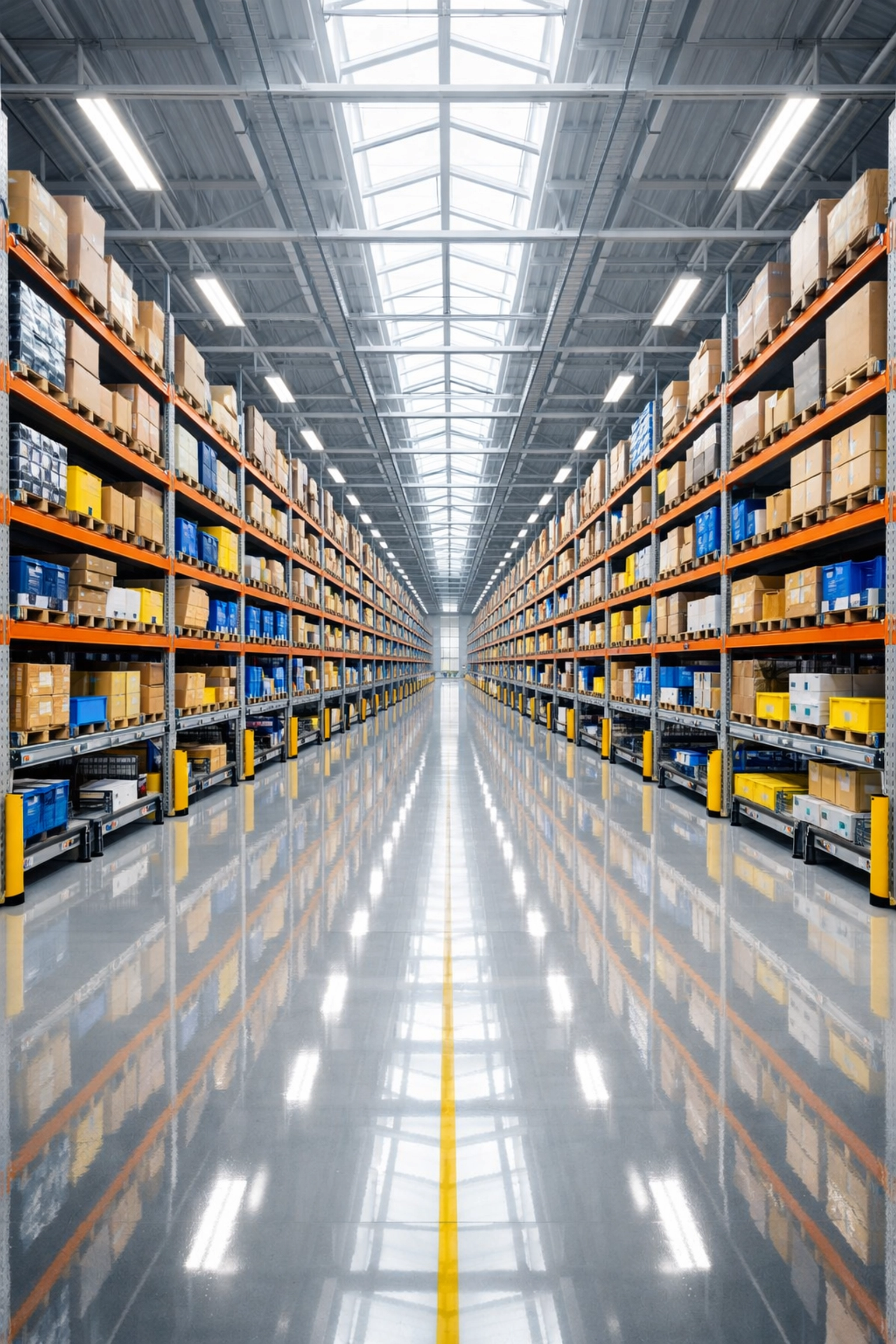
So, what is the alternative? For most brands, the answer is a high-performance, single-node fulfillment center located in a strategic, central, or high-volume hub.
At FBMFulfillment.com, we’ve seen the “national warehouse myth” play out repeatedly. Brands come to us after being burned by the complexity of distributed fulfillment. They realize that the perceived savings of lower shipping zones were completely swallowed by the costs we’ve discussed above.
The Power of One:
- Simplified Inventory: You have one pool of stock. You know exactly what you have. No rebalancing, no internal freight, no “out of stock in the East” while the West is overflowing.
- Zero Split Orders: Every item is in one building. One pick fee. One box. Maximum profit.
- Concierge Service: You have one team to talk to. They know your brand, they know your products, and they care about your success.
- Speed Without the Stress: By leveraging high-speed services like FedEx 2-Day or UPS ground from a central location, you can still reach the vast majority of the country in 2-3 days without the inventory headache.
THE 2-DAY DELIVERY WORKAROUND
The main reason people want multiple warehouses is to compete with Amazon’s speed. But you can achieve “Amazon-like” speeds from a single location if your 3PL is efficient.
By using a single-node center that prioritizes same-day shipping and has deep integrations with carriers, you can offer 2-Day delivery nationwide. It’s often cheaper to pay for a slightly more expensive shipping service on a single order than it is to maintain the massive overhead of a secondary warehouse.
Plus, for those doing Amazon FBM/FBA hybrid listings, having a single reliable hub to feed your FBA shipments and handle your FBM orders ensures your inventory counts stay accurate across the board.
CONCLUSION: STOP CHASING THE DOTS
If you have very few, very heavy SKUs, go ahead: spread them out. But for everyone else, stop chasing the dots on the map.
The goal of your logistics strategy should be Maximum Profitability and Minimum Friction. Adding more warehouses usually does the exact opposite. It creates friction, adds “stealth” costs, and detaches you from the people handling your brand’s reputation.
Stick to a single, high-performance node. Master your inventory management. Focus on your marketing and sales. Let your 3PL handle the heavy lifting from one reliable base of operations. Your bottom line: and your sanity: will thank you.

Ready to simplify your fulfillment and stop paying for the “National Warehouse Myth”? Contact us at FBMFulfillment.com and we will be glad to help you analyze your current shipping data to find the most profitable path forward.
Beware the Rise of Fly-by-night, Under-Capitalized Ecommerce 3PL Startups and the Risks to Sellers
The Ultimate Glossary of Ecommerce Fulfillment and Inventory Management Terms