
SKU Secrets: The Foundation of a Scalable E-commerce Business Empire
Let’s talk about something unsexy but absolutely critical: your SKU system.
Most sellers treat SKUs like an afterthought. They slap together random letters and numbers, use whatever their supplier suggests, or: worst of all: use different SKUs for the same product across different platforms. Then six months later, they’re drowning in inventory chaos, wondering why their warehouse keeps shipping the wrong products and their accounting looks like a dumpster fire.
Your SKU system is the foundation of your entire operation. Get it right from day one, and scaling becomes infinitely easier. Get it wrong, and you’ll be untangling that mess for years.
The SKU Structure: General to Specific (Left to Right)
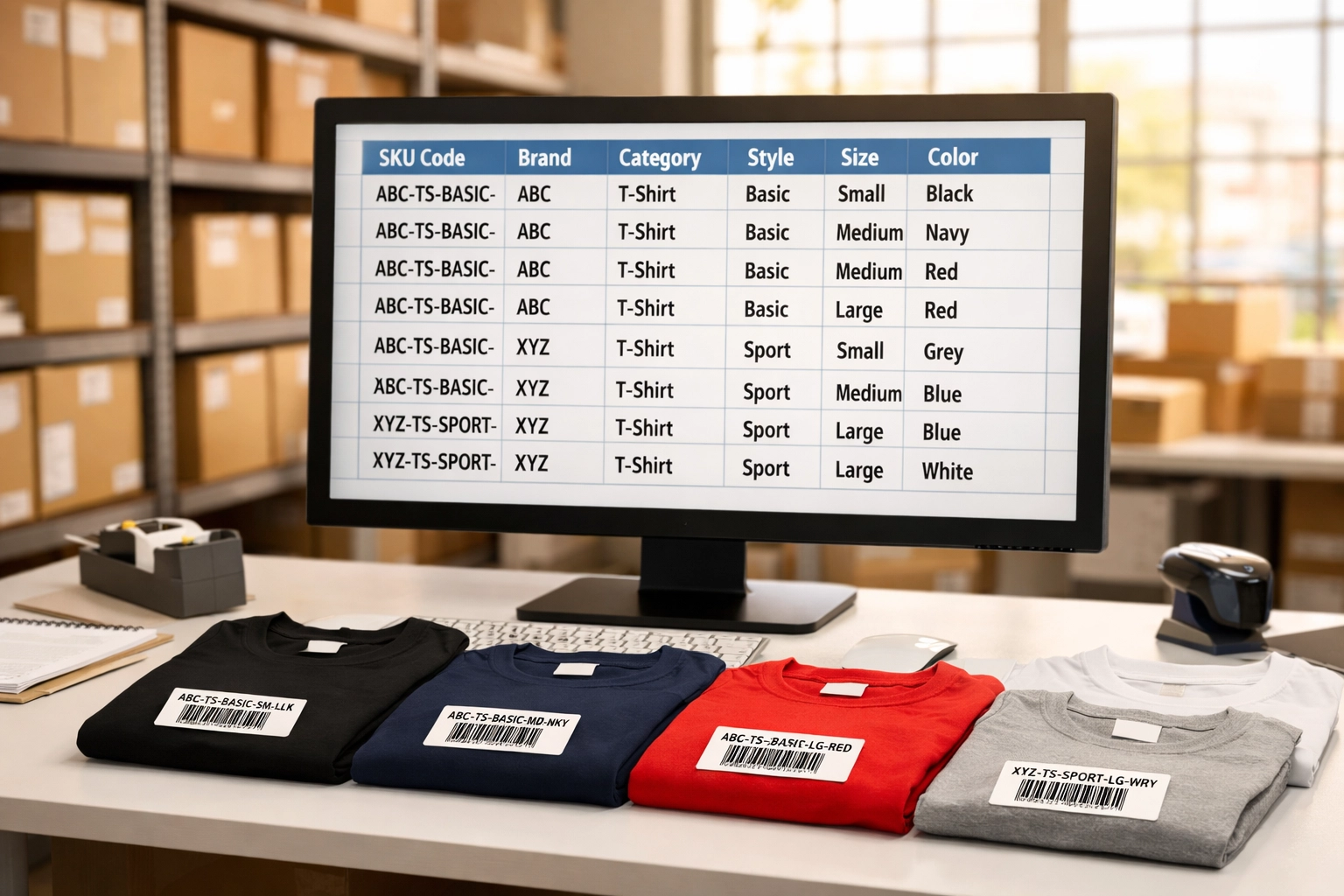
Here’s the principle that separates the pros from the amateurs: structure your SKUs from general to specific, reading left to right.
Think of it like an address. You don’t start with the apartment number: you start with the country, then the state, then the city, then the street, then the apartment. Your SKU should work the same way.
Example structure:
- ACME-TSH-CRW-LG-BLK
- ACME = Brand
- TSH = Category (T-Shirt)
- CRW = Style (Crewneck)
- LG = Size (Large)
- BLK = Color (Black)
This left-to-right hierarchy makes everything easier. When you’re looking at your inventory report, all your t-shirts are grouped together. All your crewneck styles are grouped together. Your brain (and your warehouse management system) can process information faster.
Compare that to a random SKU like “BLK947LG” or “Item-492738.” What is that? Who knows. You’ll be cross-referencing spreadsheets every single day.
Plan for the Long Term (Or Regret It Forever)
When you’re just starting out with 10 products, any SKU system feels manageable. But what happens when you have 100 products? 1,000 products? Multiple brands?
Don’t create a SKU system you’ll outgrow in six months.
If you’re using a two-letter brand code, what happens when you acquire a second brand? If your category codes are too narrow, what happens when you expand into new product lines?
Build flexibility into your system from the start:
- Use 3-4 character brand codes (room for multiple brands)
- Keep category codes consistent and scalable (TSH, HDY, HAT, ACC)
- Reserve character positions for future attributes you might need
- Document your naming conventions so anyone on your team understands the system
The time you spend planning your SKU structure now will save you hundreds of hours down the line.
The Golden Rule: Uniform SKUs Across ALL Platforms
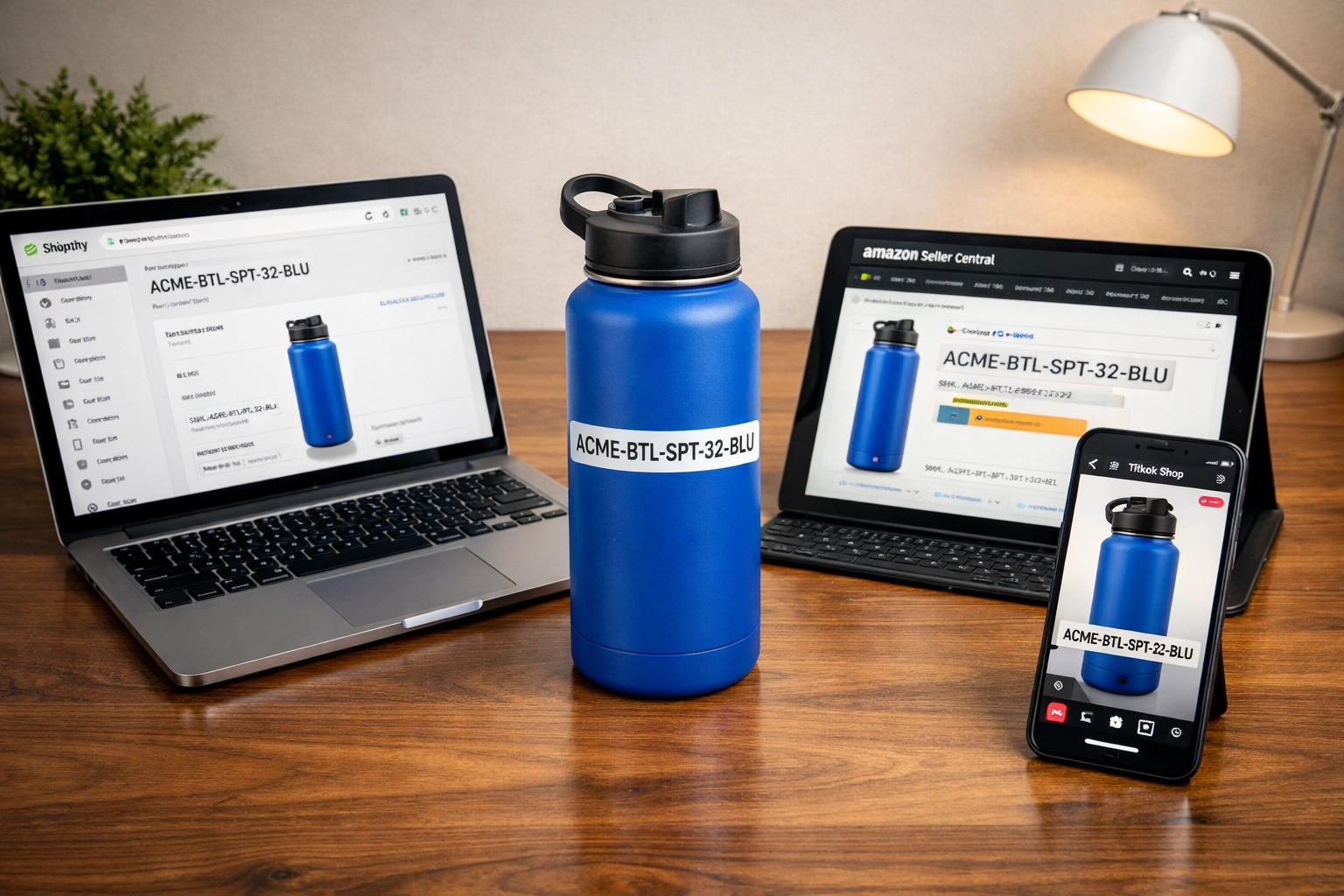
Read this twice: Your SKU must be exactly the same across every single selling platform.
Amazon. Shopify. TikTok Shop. Walmart. Your 3PL warehouse. Your accounting software. Your freight forwarder. Everywhere. The. Same.
Using different SKUs for the same product on different platforms creates unnecessary complexity, inventory errors, and complete chaos. You’ll constantly be translating between systems. Your inventory counts will never match. You’ll ship the wrong products. You’ll reorder the wrong quantities.
One SKU. One product. Everywhere.
This isn’t a suggestion. This is the law of scalable e-commerce operations. Break it at your own peril.
Formatting Rules: Keep It Clean
Your SKU formatting matters more than you think.
The rules:
- No spaces (use hyphens instead)
- No punctuation except hyphens
- Keep it readable by humans and machines
- Use uppercase for consistency
Bad SKUs:
- ACME TSH CRW LG BLK (spaces cause problems in databases)
- ACME.TSH.CRW.LG.BLK (periods can confuse some systems)
- acme/tsh/crw/lg/blk (slashes are a nightmare)
Good SKU:
- ACME-TSH-CRW-LG-BLK
Clean. Simple. Works in every system.

The Vocabulary Lesson: SKUs, Barcodes, ASINs, and FNSKUs
Let’s clear up some confusion. These terms are not interchangeable:
SKU (Stock Keeping Unit): Your internal product identifier. You create this. It’s unique to your business. It never changes, even if you sell on multiple platforms.
SKU-Wikipedia
Barcode: The machine-readable representation of a code. A barcode is just the visual symbol: the lines and spaces that a scanner reads. Any alphanumeric string can be printed as a barcode (Code 128, Code 39, etc.).
UPC (Universal Product Code): A specific type of barcode assigned by GS1 that’s universally recognized across retail. You need these for Amazon and most retail environments.
UPC-Wikipedia
ASIN (Amazon Standard Identification Number): Amazon’s unique identifier for product listings. Amazon assigns this. You don’t create it.
FNSKU (Fulfillment Network Stock Keeping Unit): Amazon’s identifier for your specific product when you’re using FBA. It’s how Amazon tracks your inventory in their warehouse, separate from other sellers’ inventory of the same product.
Here’s the key: Your SKU is yours forever. ASINs and FNSKUs are Amazon’s. UPCs are universal. They’re all different, and they all serve different purposes.
GS1 Barcodes: The Industry Standard
Quick note on GS1 barcodes: These are legitimate, globally recognized UPC codes assigned by GS1, the official barcode standards organization.
Amazon (and most major retailers) strongly prefer GS1 barcodes. While you can sometimes get away with using Amazon-generated barcodes for online-only sales, if you ever want to sell in physical retail or look remotely professional, you need GS1.
Get your GS1 company prefix. Assign UPCs properly. Don’t buy sketchy barcodes from random websites. Do it right.
Machine-Readable Codes: Not All Barcodes Are UPCs
Here’s something that trips people up: any string of characters and numbers can be printed as a machine-readable barcode.
Your SKU: ACME-TSH-CRW-LG-BLK: can be printed as a Code 128 barcode and scanned by any barcode scanner. That doesn’t make it a UPC. It doesn’t make it an FNSKU. It’s just your SKU in barcode format.
This is useful for internal warehouse operations. Your 3PL can scan your SKU barcodes to track products, pick orders, and manage inventory: completely separate from the UPC codes that Amazon or retail stores require.
Don’t confuse the format (barcode) with the specific standard (UPC, FNSKU). They’re different things.
Master Carton Strategy: Case-Level Management
Here’s something most sellers overlook until it becomes a massive problem: you need separate SKUs for your master cartons.
When your products arrive from the factory in cases of 6, 12, or 24 units, your warehouse needs to track those cases as distinct inventory items.
The solution: Add a “-CS” suffix to create master carton SKUs.
- Individual unit: ACME-TSH-CRW-LG-BLK
- Master carton (12-pack): ACME-TSH-CRW-LG-BLK-CS
Why does this matter?
1. Case-level inventory management: Your 3PL can track and store cases without breaking them open, which saves labor costs.
2. Easier FBA replenishment: Sending cases to Amazon FBA becomes infinitely simpler when you can scan and ship at the case level.
3. Wholesale orders: If you sell wholesale, buyers order in cases. Having case SKUs makes order fulfillment clean and accurate.
4. Cost savings: At FBMFulfillment.com, we can store and manage your inventory more efficiently at the case level, which translates to lower costs for you.
Label your master cartons properly. Create the case SKUs in your WMS. Your future self will thank you.
Factory Final Inspection: Scannability Is Non-Negotiable
You’ve created the perfect SKU system. You’ve printed labels. Everything looks great.
Then the shipment arrives at your warehouse, and nothing scans.
The barcode print quality is garbage. The labels are smudged. The contrast is too low. Your warehouse team is manually typing in every SKU, slowing everything down and introducing errors.
The fix: Make scannability part of your final factory inspection.
Before the container ships, scan every barcode:
- Individual unit UPC codes
- Master carton SKU barcodes
- Any other codes on the packaging
Use a handheld scanner. If it doesn’t scan cleanly, reject it. Make the factory reprint. This is non-negotiable.
A $50 scanner at the factory will save you thousands of dollars in labor costs and errors at your warehouse.
Your SKU system is boring. It’s tedious. It’s not as exciting as launching new products or scaling ad spend.
But it’s the foundation everything else is built on. Get it right: structured, uniform, clean, and scalable: and your operations will run smoothly as you grow. Ignore it, and you’ll spend years drowning in preventable chaos.
Start with a solid SKU system. Your warehouse team, your accountant, and your sanity will thank you.
The Multi-Warehouse Myth: Why More Locations Can Be a Massive Hidden Cost
The Ultimate Glossary of Ecommerce Fulfillment and Inventory Management Terms
SKU Secrets: What is a SKU and Why is it the DNA of Your Business?